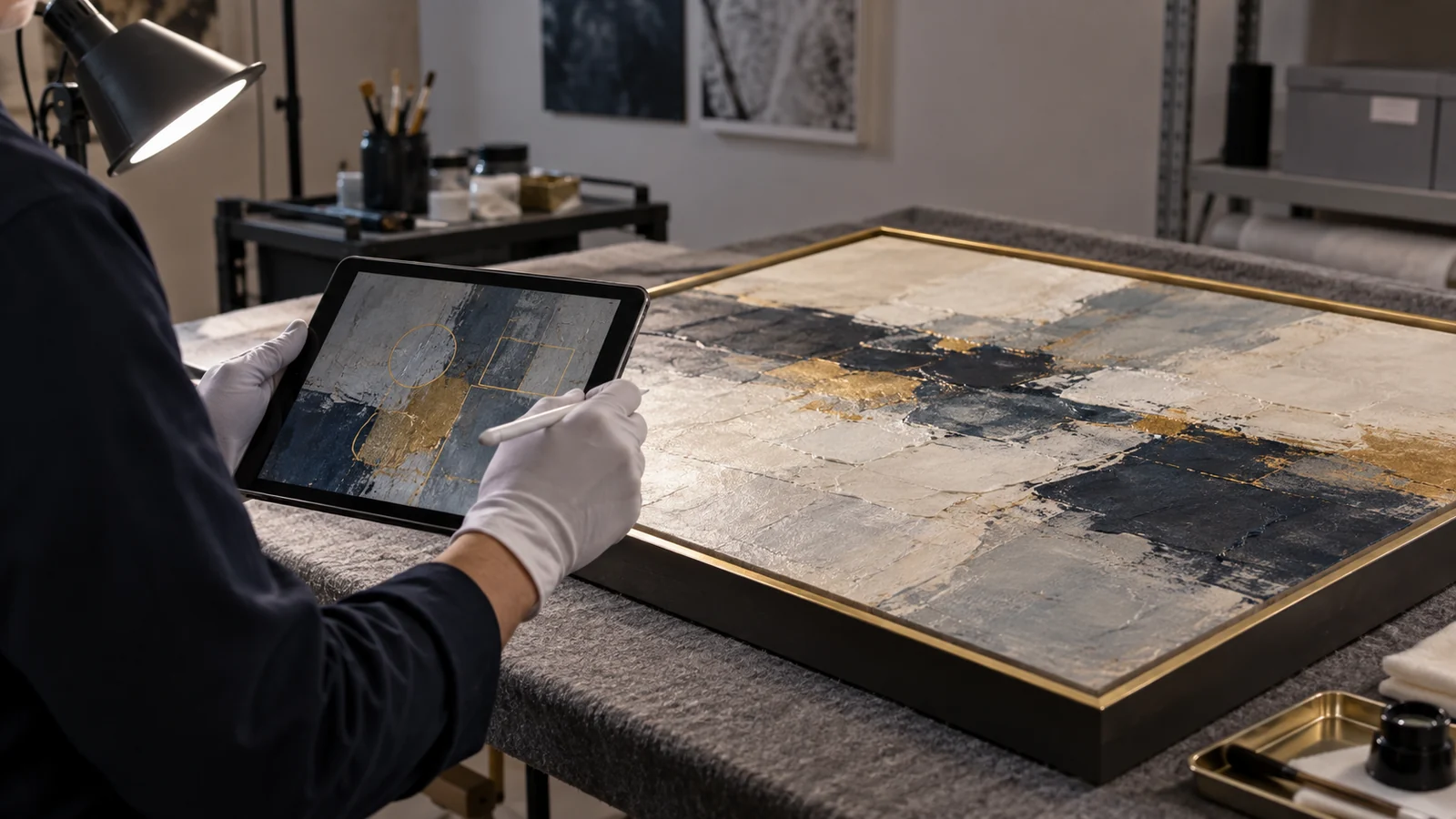
Every time a work of art changes hands, changes walls, or changes buildings, someone should ask a simple question: is it in the same state it was before? A condition report creates a contemporaneous record that helps owners, handlers, conservators, lenders, and insurers compare what was observed at different points in time.
Done well, a condition report is specific, repeatable, and useful to later reviewers. It does not establish ownership or automatically decide responsibility, but it can provide important evidence when a change is investigated.
What a condition report is for
A condition report serves three audiences at once:
- The owner or custodian, who needs a record of the object’s observed state.
- The handler, who needs clear information before packing, moving, or installing the object.
- The conservator, lender, or insurer, who may need a dated baseline when reviewing later changes.
Because it serves all three, the report cannot be a matter of opinion. It has to be observational, specific, and consistent from one examiner to the next.
When to create one
The appropriate timing depends on the object, agreement, and operating procedure. Common review points include:
- On intake to storage or a facility
- Before and after any transit
- At installation and de-installation for a loan or exhibition
- After any environmental incident — a climate excursion, water event, or handling accident
Before-and-after comparisons around transit make it easier to identify when a change first appeared. The report should be read together with photographs, handling records, movement history, and the relevant agreement.
What to record
Consistency matters more than length. A good report walks the object the same way every time — front to back, top to bottom — and describes what is actually visible.
Structure and support
Note the material and construction: stretched canvas, panel, paper, sculpture medium, and the state of the support itself — keys, backing boards, mounts, or plinths.
Surface
Document the condition of the working surface: craquelure, flaking, losses, abrasions, accretions, discoloration, or prior restoration. Locate each finding precisely.
“Small loss, lower left” is a note. “3mm paint loss, 40mm in from the left edge and 60mm up from the bottom edge” is a record.
Frame and glazing
The frame is part of the object’s condition and often takes the hit in transit. Record chips, corner separations, and any contact between glazing and the surface.
Existing damage
Pre-existing issues are the whole point. Documenting them protects everyone — it is what separates old damage from new.
Photography is half the report
Photographs help corroborate written observations. A useful report pairs findings with images that a later reviewer can match to the object:
- An overall shot of each face
- Raking light across the surface to reveal texture and deformation
- Detailed macro shots of every noted condition issue
- Consistent, color-accurate lighting so tomorrow’s photo is comparable to today’s
The goal is simple: someone who has never seen the piece should be able to locate every finding you describe.
Make it consistent and traceable
A condition report is only as trustworthy as the process behind it. That means:
- Standardized fields so every examiner records the same things the same way
- A unique identifier linking each report to the specific object and its location history
- Dated records, role-based access, and retained audit history so authorized reviewers can understand later changes
- A clear chain showing who examined the work, when, and where
When condition reports live alongside movement and environmental history, reviewers have a clearer record of what was observed, when it was recorded, and which operational events surrounded it.
The bottom line
The best condition report is clear enough for another trained reviewer to understand without guessing. For a high-value collection, consistent description, photography, identity, access control, and audit history make the record materially more useful.
Primary references
- Canadian Conservation Institute: Condition Reporting—Paintings, Part I
- Canadian Conservation Institute: Examination Techniques and Checklist
Condition examination is a trained activity. Use a qualified conservator for fragile, complex, high-risk, or disputed objects and follow the applicable lender, insurer, and institutional requirements.
Reader discussion
Discussion
No published comments yet.
A verified email is required, and comments are reviewed before publication. The discussion service loads only after you choose to join. See the ArtWMS Privacy Policy and FastComments Privacy Policy.